Water Stain on Ceiling? How to Find the Source of the Leak
A ceiling water stain almost never sits directly under the leak. Here is how to trace it back to the real source in Greenville NC before the drywall comes down.
Finding the source of a ceiling water stain means tracing the water back to its entry point, not the spot where it drips. Water follows joists, pipes, and slope, so the stain on your ceiling in Greenville NC is usually 3 to 10 feet away from the actual leak. This post walks you through the exact steps we use on service calls, what causes stains in the first place, and when it is time to stop looking and call someone.
Why the Stain Is Almost Never Under the Leak
Water travels along the path of least resistance before it ever shows up on drywall. It runs down a pipe, pools on top of a joist, then drips at the lowest point of that joist - which can be several feet from the break. That is why a stain in the middle of a hallway often traces back to a bathroom on the other side of the wall.
Greenville homes make this worse than most. The clay soil here holds water after heavy rain, and slab-on-grade construction - common in neighborhoods built from the 1960s through the 1990s - means supply lines run under the concrete. When one of those lines fails, water wicks up through the slab and finds a seam in the ceiling below. We see this pattern repeatedly in older homes off East 10th Street and around the ECU campus area.
One more thing: gravity is not the only force at work. Capillary action pulls water sideways through insulation and wood. A slow leak can travel 15 feet horizontally before it drops. That is why the stain keeps growing even after you think you have found the source.
What Causes Water Stains on Ceilings in Greenville NC
Water stains on ceilings in Greenville NC come from a short list of culprits, and the fix depends entirely on which one you have. Here are the ones we see most often, roughly in order of frequency.
- Supply line leaks. A pinhole in a copper or PEX line above the ceiling. These start small and grow fast. A 1/8-inch pinhole can release 2 to 3 gallons per hour.
- Drain line leaks. A cracked fitting or loose joint in a drain pipe. These only leak when the fixture is in use, which is why the stain sometimes looks dry for hours.
- Toilet and shower leaks. A failing wax ring or a cracked shower pan lets water seep into the subfloor and drip below. If the stain is near a bathroom, this is your first suspect.
- HVAC condensate. A clogged condensate drain line backs up and overflows the pan. In Greenville's humid summers, this happens more than people expect.
- Roof and flashing leaks. Missing shingles or failed flashing around a vent pipe. These show up after heavy rain, not during dry spells.
- Slab leaks. A supply line under the foundation fails and water migrates upward. These are the hardest to trace and the most expensive to ignore.
If your water bill jumped 20 percent or more with no change in habits, the ceiling stain and the bill are probably the same problem. We handle high water bill leak detection Greenville NC with acoustic and thermal gear that pinpoints the line without tearing up the floor.
How Do I Find the Source of a Ceiling Leak in Greenville NC?
You find the source of a ceiling leak in Greenville NC by isolating fixtures one at a time, watching the stain, and following the water back to its entry point. Do these steps in order. Most homeowners find the culprit within an hour.
- Stop the water. Shut off the main valve if the stain is actively dripping. If it is a slow seep, leave the water on - you need flow to trace it.
- Mark the stain's edges with tape. Use painter's tape. If the stain grows past the tape in 30 minutes, you have an active leak. If it does not, you are dealing with a slow one.
- Run one fixture at a time. Fill the tub, then drain it. Flush the toilet three times. Run the shower for 10 minutes. Wait 15 minutes after each test and check the stain.
- Check the attic or crawlspace. Look for wet insulation, dark streaks on joists, or standing water. Water leaves a trail. Follow it.
- Test the HVAC. Pour a cup of water into the condensate pan. If it does not drain, you found a clog - and probably your stain.
- Look outside. If the stain only appears after rain, the roof or a wall penetration is the source, not the plumbing.
If the stain sits near a bathroom wall and the floor feels soft, a shower pan or drain leak is likely. Our ceiling leak detection Greenville NC service uses moisture meters and infrared cameras to confirm the exact point before we open anything up.
Tools That Actually Trace a Ceiling Leak
You do not need a truck full of equipment to trace a ceiling leak, but four tools make the job faster and more accurate. Here is what we carry and what each one does.
- Moisture meter. Reads the water content in drywall and wood. A reading above 20 percent means active moisture. Below 15 percent means the area is drying.
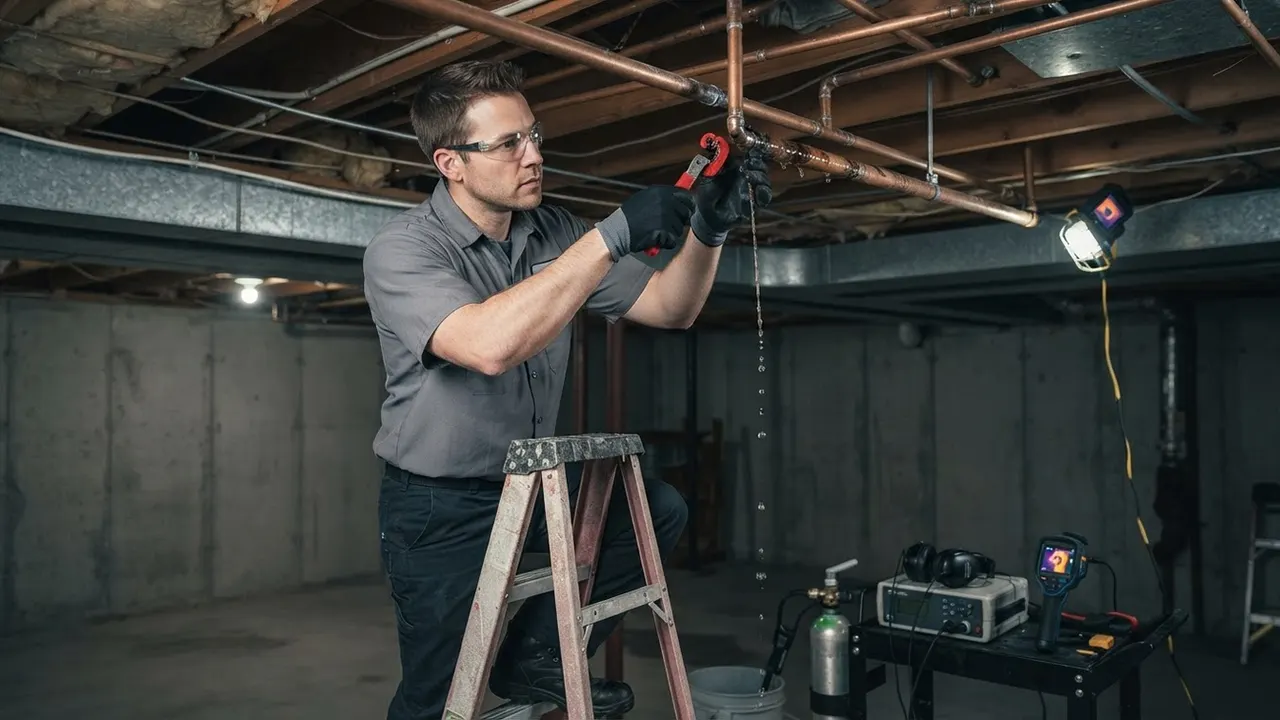
- Infrared camera. Shows temperature differences caused by evaporating water. We can scan a 10-foot ceiling in under two minutes and see the leak path as a cool streak.
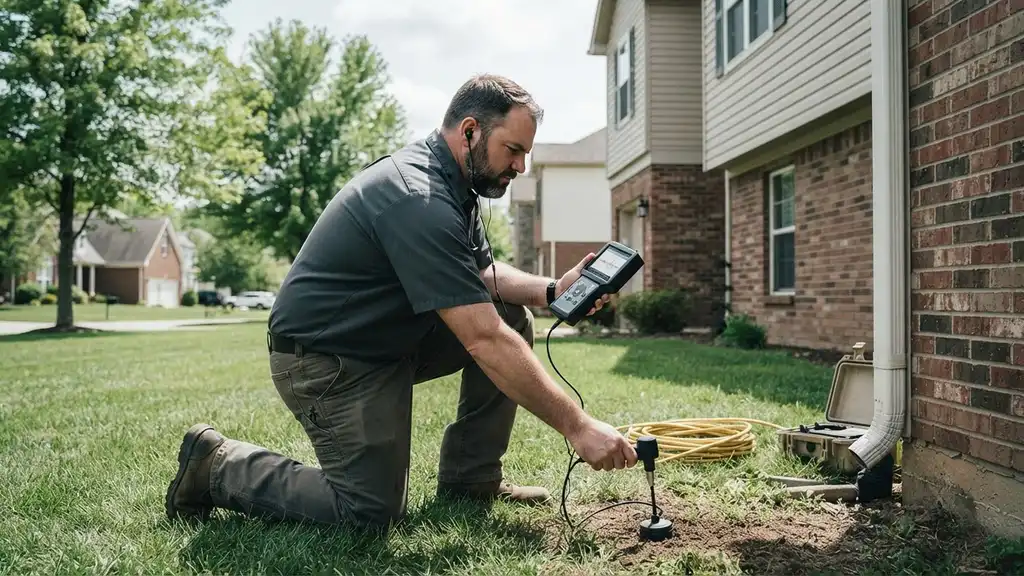
- Acoustic listening disc. Picks up the sound of pressurized water escaping a pipe. Works best on lines running through walls or under slabs.
- Pressure gauge. Confirms whether a supply line is losing pressure. A drop of 5 psi over 15 minutes with all fixtures off points to a hidden leak.
For leaks under the foundation, we add thermal imaging and a line locator. That combination lets us mark the exact spot on the floor before we cut concrete. We have run this process on slab leaks across Leak detection in Winterville NC, where the same clay soil and older plumbing create the same problems we see in Greenville.
What to Watch Out For
Three mistakes turn a $300 repair into a $3,000 one. Avoid them.
Do not paint over the stain. Stain-blocking primer hides the mark but not the moisture. The leak keeps running, the drywall keeps softening, and mold gets a head start. Fix the water first, then paint.
Do not assume the roof is the problem. In Greenville, we get called for roof leaks that turn out to be supply lines 60 percent of the time. If the stain grows when no rain is falling, it is plumbing.
Do not ignore a slow drip. A leak that drips once every 30 seconds wastes about 3 gallons a day. Over a year, that is more than 1,000 gallons - and enough moisture to rot a joist.
One more: if you see a brown ring with a white or gray center, the leak has been active for weeks. The ring is the dried edge; the center is where water is still moving. Call someone.
Can a Ceiling Leak Be Repaired Without Replacing Drywall?
Yes, a ceiling leak can often be repaired without replacing drywall if the leak is found early and the drywall has not sagged or crumbled. We cut a small access hole - usually 4 to 6 inches - repair the pipe or fitting, then patch the hole. The patch is invisible after paint.
You do need to replace drywall when the sheet is soft, sagging, or stained across more than 2 square feet. Mold is another trigger. If you smell a musty odor or see dark spots, the drywall has to come out. There is no safe way to seal mold behind a wall.
Typical 2026 pricing in this area runs $250 to $600 for a small access repair and patch, and $800 to $1,800 if a full sheet of ceiling drywall has to be replaced and painted. The leak repair itself is separate and depends on what failed.
When to Call a Professional
Call a professional when the stain grows while all fixtures are off, when you cannot access the space above the ceiling, or when the water bill has jumped without explanation. Those three signs point to a hidden leak that DIY tracing will not find.
We find the leak, fix it, and test the line before we leave. Our technicians carry moisture meters, infrared cameras, and acoustic gear on every truck, so most ceiling leaks are located in under an hour. If the source turns out to be under the slab, we handle that too - no need to call a second company.
If you are in Ayden, Farmville, or Washington, we cover those areas as well. Homeowners there deal with the same aging supply lines and humid summers, and we run the same process on Ayden NC leak detection calls that we do in Greenville proper.
Frequently Asked Questions
How do I find the source of a ceiling leak in Greenville NC?
Shut off the water if it is actively dripping, mark the stain with tape, then run one fixture at a time and watch for growth. Most ceiling leaks trace back to a supply line, drain fitting, or HVAC condensate pan within 30 to 60 minutes of testing.
What does a water stain on the ceiling mean in Greenville North Carolina?
A water stain means moisture is reaching the drywall from above. A brown ring with a lighter center indicates an active leak. A dry, uniform stain usually means the leak has stopped but the damage remains. Either way, the source needs to be confirmed.
Can a ceiling leak be repaired without replacing drywall in Greenville?
Yes, if the drywall is still firm and the stain is under 2 square feet. We cut a 4 to 6 inch access hole, repair the leak, and patch it. Sagging, crumbling, or moldy drywall has to be replaced - there is no safe shortcut.
Who should I call for a ceiling water stain in Greenville NC?
Call a leak detection specialist first, not a drywall contractor. The stain is a symptom. A leak detection company finds and fixes the source, then the drywall can be repaired. Calling a painter first just hides the problem for a few weeks.
How much does ceiling leak detection cost in Greenville NC?
Most residential ceiling leak inspections run $150 to $350 in 2026, and that fee is often applied to the repair if you move forward. Slab or underground leaks cost more to locate because they require acoustic and thermal equipment.
Get Help With Leak Detection in Greenville
A ceiling stain is a warning, not a cosmetic problem. The longer it sits, the more drywall, insulation, and framing it takes with it. We locate the source, fix the leak, and confirm the line holds before we pack up.
Call Greenville Leak Detection Pros at +923139383014 and we will get a technician to your door.